



Programme for education and allocation of guide and mobility assist dogs
The implementation of this programme commenced on April 2, 2007, when the Agreement on Cooperation and Training of Guide and Assistance Dogs for Beneficiaries from Montenegro was signed.
This agreement was signed with Croatian Guide Dog and Mobility Association for period of five years, with possibility of extension.
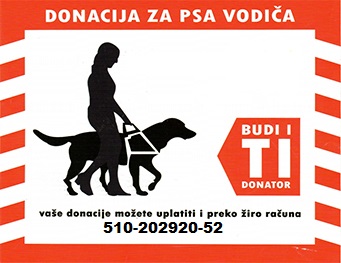
AYDM conducts campaigns to raise funds for the training of guide dogs and dog helpers, and implements educational campaigns aimed at raising public awareness about the possibilities of these dogs, rights related to the beneficiaries of dogs assistants, encourage PWD to move around independently and greater mobility in everyday life, aimed at their better integration into society.
Some of the most known trained dogs, providing assistance to persons with disabilities worldwide, are:
* Guide dog for the visually impaired,
* Mobility assist dogs or rehabilitation dog for wheelchair users,
* Therapy dog for children with disabilities and intellectual limitations,
* A dog that responds to different types of sound signals and gives signal to hearing impaired person, turning their attention to various situations, danger, door bell, crying of a baby, etc.
In Montenegro there are two guide dogs for visually impaired persons and one assistance dog for wheel chair user. Xena and Jan are guide dogs, while Luna is assistance dog. Here you can see photos of our lovely assistants and pets!
Law on the Movement of PWD with assistance dog regulates the rights of persons who use such trained dogs and sets penalties for violators (legal and natural persons) of provisions of this Law.
Guide dog is trained to help (lead) safely and easily a person, with a complete or high degree of visual damage, to the point which the user sets as the target. These dogs successfully avoid numerous obstacles on pavements, roads, in facilities and the like. They lead the person to the entrance and/or exit stairs, find the doors on various buildings or transport, and for many years (on average 7-9 years) go together in every life adventure, problem, success, and people often perceive the person and the assistant as one being, and for that reason legal standards of most countries are oriented to that perception. Where the user can enter the assist dog can enter as well, because the dog is walking one step ahead of the user, choosing the safest route for both of them.
While the dog is wearing a harness (it is a working suit for a dog) it is not recommend to pet or touch the dog before asking the guided person to first stop, so you could touch the dog. this is a working dog suit), not recommended to petting and touching, before you contact the person that the dog leads and ask them to stop, to stroke my dog. Equipment for harness for mobility assist or guide dog looks like this <graphic>
However, although they are trained in completely different way and are trained to obey various commands, assist dogs also have one noble role, as well as guide dogs. They assist wheelchair users in a way they reach for and fetch various items, open and close doors, switch the lights on and off, to get out of the bed, etc. Thos dogs are also called rehabilitation dogs, although they can be placed under the title “assistant dogs”. Equipment for harness (working suit) for assistant dogs looks like this < GRAFIC>
AYDM implements this programme for Montenegro, and assists interested persons to enter the process for allocation of guide dogs or assist dogs, adult Montenegrin citizen, wishing to apply for guide/assist dog, must fill in the application form for guide dog or application form for assist dog.
Once the potential beneficiary submits the application, the next step is detailed testing and comprehensive discussion with instructions from the Centre “Silver” from Zagreb, Croatia, who are, among other things, involved in raising and training these dogs.